01A town of its own
The history of the area begins, of course, long before there was a place called Lents. The land sits within the traditional homelands of Indigenous peoples of the lower Columbia and Willamette region, including Chinookan-speaking peoples whose communities, trade networks and relationships with this land existed for generations before American settlement. Euro-American settlement accelerated in the middle of the 19th century following the Oregon Trail migrations, and among the settlers who arrived in the area were Oliver Perry Lent and Martha Lent, who established themselves near Johnson Creek. Oliver operated a sawmill and became involved in establishing an early post office and mail route, while the Lent family became increasingly connected to the little community growing around them.
The community began developing surprisingly early. Local families organized School District No. 12 in 1860, more than three decades before Lents was formally laid out as a town. Oliver’s son, George P. Lent, officially platted the Town of Lent in 1892, the same period in which an interurban railway helped connect the settlement with Portland. Somewhere along the way, people began referring to a trip out here as going to “Lent’s.” Eventually the apostrophe disappeared, the S remained, and Lents became the name that stuck.
By the beginning of the 20th century, Lents wasn’t simply some distant residential outpost of Portland. It was a functioning town with a commercial center serving families, farmers and workers throughout southeast Multnomah County. The crossroads around what is now SE 92nd Avenue and Foster Road became the heart of the community. There were grocers, hardware and furniture stores, a bakery, clothing stores, real estate offices, a drugstore, barbers, churches and even a roller rink. The I.F. Coffman General Store stood near the center of it all. By 1905, Lents had developed into a genuine little business district, and the interurban railway allowed residents to travel into Portland while still maintaining a commercial and community life of their own.
Lents wasn’t created as a Portland neighborhood. Portland eventually grew to Lents.
That’s an important distinction in understanding the neighborhood today.
02Portland grew to Lents
As the city expanded eastward, it gradually surrounded the community, and in 1912 Lents was annexed into Portland. On paper, the independent town was gone, but its identity proved considerably harder to erase. Its distance from Portland’s traditional center helped Lents retain some of the character of the independent community it had been, even as the city around it continued to change.
Transportation would eventually reshape Lents again. When 82nd Avenue became a state highway in 1932, commercial development increasingly shifted toward the new automobile corridor. Fred Meyer opened at 82nd and Foster in 1950, Eastport Plaza followed in 1960, and retail activity that had once centered around the historic Lents crossroads increasingly migrated west. The old commercial district around Foster and 92nd began a long period of decline.
Right in the middle of those changing decades, however, Lents briefly became home to one of the most important American songwriters of the 20th century.
03Woody Guthrie lived here
In 1941, Woody Guthrie lived in Lents. Guthrie had come to the Pacific Northwest after being commissioned to write songs connected to the Columbia River and the enormous public works and hydroelectric projects transforming the region. During his time here, Guthrie and his family stayed for a period in an apartment in Lents, in a building that had previously housed the Lents Library and Reading Room. His brief stay in the Northwest became an extraordinarily productive period, producing songs about the Columbia River, dams, migrant workers and the people reshaping the Pacific Northwest—the body of work now associated with his Columbia River songs.
His connection to the neighborhood is still remembered through Woody Guthrie Place near SE 91st and Reedway. It’s a wonderfully unexpected piece of local history: one of America’s great folk songwriters once looked out at this corner of Southeast Portland and, however briefly, called Lents home. There is something fitting about it, too. Guthrie spent much of his career documenting working people, migration, labor, displacement and communities that weren’t always considered important enough to have songs written about them. Lents has spent a fair amount of its own history being underestimated in much the same way.
04The freeway
Perhaps nothing physically transformed the neighborhood more dramatically than Interstate 205. Planning and construction of the freeway through East Portland culminated during the 1970s and early 1980s, and its route went directly through the historic Lents community. Homes were acquired and demolished, residents were displaced, and long-established streets and neighborhood connections were disrupted. A community that had once grown outward from a walkable town center suddenly had a major interstate running directly through it. You can still see the consequences simply by looking at a map. I-205 didn’t merely pass near Lents; it divided it.
Combined with the earlier migration of commercial activity toward 82nd Avenue, the freeway contributed to the decline of the old town center. For years afterward, Lents developed a reputation throughout Portland that often seemed to focus more on what the neighborhood supposedly lacked than on the people who actually lived here. But communities are more complicated than their reputations, and Lents kept going.
05The giant penny
For a huge portion of modern Lents history, one of the neighborhood’s most recognizable symbols was impossible to miss. Beginning in the early 1970s, Theodosios “Saki” Tzantarmas built the New Copper Penny into a sprawling neighborhood institution near Foster and 92nd. Over time it grew to include a restaurant, nightclub, banquet facilities and other entertainment, occupying a significant piece of the historic commercial district. But for many Portlanders, the most memorable part of the Copper Penny wasn’t inside the building at all. It was towering above it.
The enormous illuminated New Copper Penny sign, with Abraham Lincoln’s profile glowing over 92nd Avenue, became one of Southeast Portland’s unmistakable roadside landmarks. Generations of people traveling I-205 knew exactly where they were when that giant penny appeared. The New Copper Penny was colorful, complicated and unmistakably part of Lents. When the property was eventually sold for redevelopment, people cared enough about that strange old landmark that efforts were made to keep the sign from simply disappearing. There’s something wonderfully Lents about that, too: even the giant penny mattered because it was our giant penny.
06This corner
The neighborhood’s history can also be followed through the ordinary buildings that have remained while the names on their signs changed. At 5836 SE 92nd Avenue, for example, the space that now houses The Common Loon spent years as the Eagle Eye Tavern and, before that, Riley’s. Riley’s became the Eagle Eye in 2012, and the Eagle Eye remained part of the neighborhood for more than a decade.
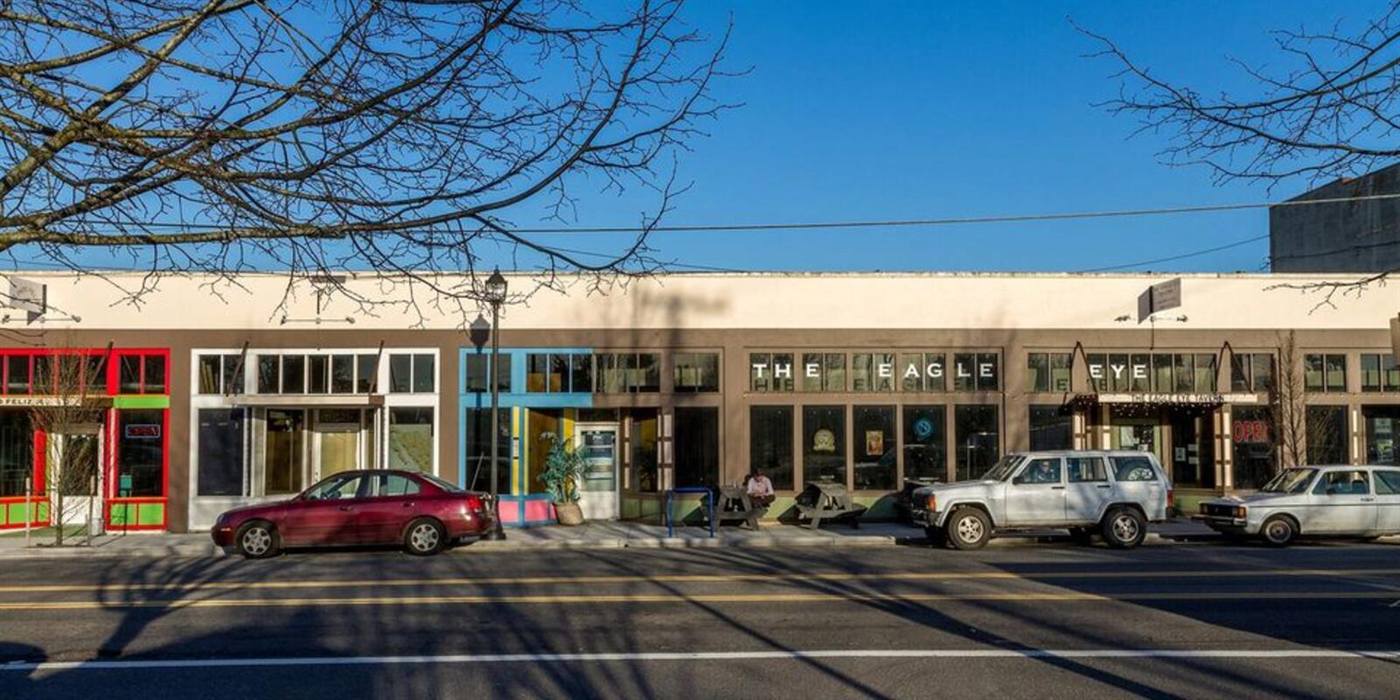
That address isn’t particularly important because the history of Lents revolves around one tavern—it certainly doesn’t—but because places like it are part of the connective tissue of old neighborhoods. Owners change. Businesses change names. Buildings are remodeled. Generations of people come through the same doors without ever meeting one another. Multiply that by hundreds of storefronts, homes, churches, schools, parks and gathering places and you begin to get the real history of a neighborhood.
07Walker Stadium
A few blocks away, another old Lents institution has found an entirely new life. Walker Stadium was originally constructed in 1956 as part of Lents Park and spent generations as the neighborhood ballpark. After a major renovation, baseball returned in a very different form when the Portland Pickles began playing there in 2016. Somehow, a collegiate wood-bat baseball team named after a pickle became one of the most recognizable pieces of modern Lents.
A summer night at Walker Stadium isn’t exactly a solemn celebration of America’s pastime. There is baseball, certainly, but there are also mascots, music, beer, ridiculous promotions and several thousand people willingly participating in whatever strange thing happens to be occurring between innings. It’s weird, fun and unmistakably Portland, but more specifically, it has become unmistakably Lents. On summer nights the stadium fills up, people walk through the neighborhood before and after games, nearby businesses see new faces, and Portlanders from other parts of the city deliberately come east because something is happening here.
That feels significant because, for a long stretch of Lents history, so much of the story seemed to be about things leaving. Businesses left the old commercial district. Homes disappeared for the freeway. Investment went elsewhere. People talked about Lents as somewhere you passed through on the way to somewhere else.
Increasingly, people are coming here instead.
08Lents today
Modern Lents is difficult to summarize because it isn’t one thing, and that’s probably the point. It’s families who have lived here for generations and people who moved here last month. It’s old houses and new apartment buildings. It’s immigrants and artists, tradespeople and musicians, small-business owners and service-industry workers. It’s baseball fans walking toward Walker Stadium, somebody carrying groceries home, somebody opening a restaurant and wondering whether anyone will show up, and somebody else taking a chance on a storefront that has already been five different things.
It’s food carts, restaurants, bars, markets, makers, artists, nonprofits, neighborhood organizations and independent businesses. It’s the old Lents and whatever Lents is becoming next, existing right alongside each other.
And maybe that’s where the future of the neighborhood gets especially interesting. Lents doesn’t need to become the next version of Alberta, Mississippi, Division or Hawthorne. It doesn’t need to borrow another neighborhood’s identity to prove that it’s worth visiting. It already has an identity. The challenge is making sure that growth adds to what is here instead of simply replacing it.
For more than a century, Lents has too often been defined from the outside by what people thought it lacked. Too far out. Too rough. Too neglected. Not enough investment. Not enough restaurants. Not enough nightlife. Not enough reasons to come here. But maybe we’ve been asking the wrong question, because Lents has always possessed something much more difficult to manufacture: a sense of itself.
That’s worth protecting, and one of the simplest ways to protect it is to support the people who are here. Go to a Pickles game and eat somewhere nearby beforehand. Walk into the little restaurant you’ve driven past fifty times. Buy something from a neighborhood maker. Get coffee from the independent shop. See a local band. Go to the market. Tip people. Tell your friends about the place you discovered. If somebody takes a chance and opens a strange little business in Lents, root for them.
The businesses here have a role in that, too. Recommend one another. Collaborate. Share customers. Put up each other’s flyers. Buy from each other when possible. Celebrate when somebody succeeds. A thriving neighborhood isn’t built because one business does extraordinarily well. It’s built when a whole bunch of independent businesses, organizations, artists and neighbors begin succeeding together.
There is room in Lents for all of it. More food, more music, more art, more baseball, more makers, more independently owned businesses, more reasons to walk down the street and more reasons to stay awhile. More reasons for somebody who grew up here to be proud of where they’re from, and more reasons for somebody who has never been here to finally come see what they’ve been missing.
09What Lents Is More means
That’s what LENTS IS MORE means to us.
It isn’t a suggestion that Lents needs to become something more. It’s a reminder that Lents has always been more than people gave it credit for—more history, more character, more community, more stories, more weirdness and more possibility.
We love Lents. And the best thing any of us can do for its next chapter is make sure we’re writing it together.
Go deeper
For anyone who wants to go much deeper into the neighborhood’s history, photographs, buildings, businesses and stories, we strongly recommend Historic Lents, Oregon at LentsHistory.com. It’s an incredible community resource, and barely scratching the surface here should hopefully make you want to lose an hour or two over there.